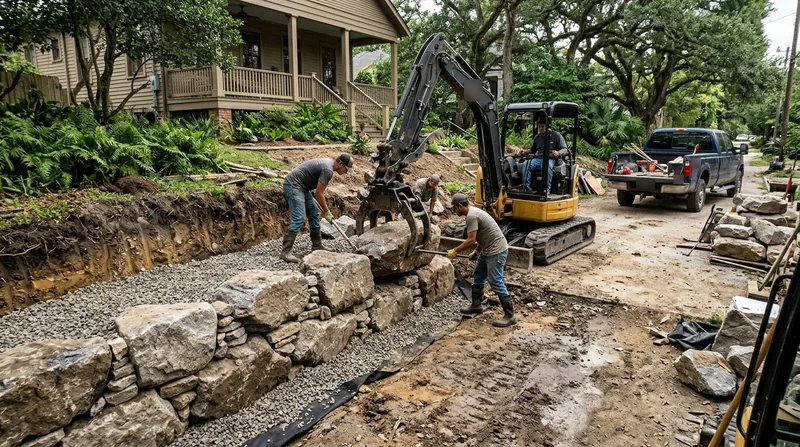




New Orleans sits on soft delta ground between the Mississippi River and Lake Pontchartrain, and a lot of it is at or below sea level. In Bywater and the Marigny, yards sit behind raised shotguns and Creole cottages where the soil is organic clay and peat that keeps settling. Uptown and the Garden District hold heavier Greek Revival and Italianate homes with brick planters and old bed edges that have shifted for decades. Out in Lakeview, Gentilly and New Orleans East, slab ranches raised after 2005 often need low stone beds and bulkhead edges that can handle a water table only a few feet down. We build Boulder & Natural Stone Walls in New Orleans with machine-placed limestone, riprap and natural stone set on a proper base with real drainage, so the wall holds its line through hurricane rain and summer cloudbursts. If you need a natural finish for a raised bed, pond edge or waterfront lot, retaining wall installation is where we start every project.
Why Boulder and Natural Stone Walls Matter on New Orleans Soil
Most wall failures in this city come from the ground, not the stone. Organic clay and peat shrink, swell and subside, and the water table sits close enough that backfill stays wet after every storm. Timber and old railroad tie edges rot fast here because Formosan termites work the wood and constant humidity finishes the job. Boulder and natural stone walls handle that movement better than rigid materials because each stone can shift slightly without cracking, and we can build in open-graded drainage behind the face.
- We set every boulder on a compacted, level base so it does not roll or settle unevenly.
- We slope the backfill and install drainage so storm water moves away from the wall instead of loading it.
- We choose stone size and shape to match the load, from low garden beds to bulkhead and riprap edges.
- We keep the wall line clear of live oak roots and raised slab footings wherever the layout allows.
That approach keeps a natural stone wall stable in the same wet, shifting ground that destroys timber edges and cracks poured concrete planters.
Key info: In Lakeview and Gentilly, we often replace rotting timber bed edges with limestone boulders set on a compacted base, which holds up far better against saturated backfill after a summer downpour. In Bywater and the Marigny, low stone planters work well against raised shotgun foundations because they flex with the clay instead of cracking.
Before any wall goes in, check the current permit thresholds with the City of New Orleans One Stop Shop, since walls above roughly 4 feet from the footing, or walls carrying a driveway or structure, usually need a permit and sometimes engineered drawings.
How We Build a Boulder and Natural Stone Wall in New Orleans
We start by reading the ground, not the catalog. On a typical New Orleans lot we check soil type, the water table, how the yard drains and where the wall ties into a raised slab, driveway ramp or bayou edge. From there we size the base, pick the stone and set the drainage before a single boulder is placed. If the wall is holding a slope or a bulkhead line, we bring in slope stabilization and erosion control measures so the stone is not fighting moving soil on its own.
- We walk the site and mark the wall line, checking setbacks and property lines.
- We excavate to the required depth and compact a crushed stone base that will not pump in wet clay.
- We set the drainage stone, filter fabric and outlet so water leaves the backfill.
- We place the boulders or natural stone with machine and hand work, seating each one solid.
- We backfill in lifts, compact as we go and finish the top to shed water.
- We clean the site and walk the finished wall with you before we leave.
Every step is done with the local soil and water in mind, because a wall that ignores drainage will lean within a couple of seasons.
Key info: On a recent job near the London Avenue Canal in Gentilly, we replaced a failed timber edge with limestone boulders set on 6 inches of compacted base with a gravel drainage core. The lot sits low, so the drainage outlet mattered as much as the stone itself.
Boulder and Stone Wall Approaches We Use
Not every yard needs the same wall. A raised planter in Uptown calls for a different build than a bayou bulkhead in Marrero or a riprap edge in Slidell. This table shows the main approaches we use and where each one fits.
| Approach | Description | Best for |
|---|---|---|
| Machine-placed limestone boulders | Large imported limestone set on a compacted base with a gravel drainage core behind the face. | Raised beds, low retaining walls and garden terracing. |
| Riprap and bulkhead stone | Graded rock placed along a bank or canal edge to resist wave and current scour. | Bayou edges, drainage canals and waterfront lots. |
| Dry-stacked natural stone | Hand-set stone with tight joints and no mortar, backed by filter fabric and drainage stone. | Low garden walls, pond edges and planter faces. |
| Stone facing on a structural core | Natural stone veneer tied to a concrete or block core where the wall carries real load. | Taller walls, driveway ramps and walls under a surcharge. |
Boulder & Natural Stone Walls Cost in New Orleans: What to Expect
Most boulder and natural stone wall work here starts around $25 per square foot of wall face, and that figure covers a straightforward low wall with standard base prep and drainage. The number moves up with stone size, haul distance, tight access through a Mid-City side yard, and how deep we have to dig to reach stable base in soft clay. Walls that carry a driveway or tie into a raised slab need more base and more stone, so they cost more per foot.
- Stone type and size, since large limestone boulders cost more than smaller garden stone.
- Access, because a narrow driveway or a fenced backyard slows machine placement.
- Drainage scope, including outlets and gravel volume behind the wall.
- Removal of an old timber or concrete edge before the new wall goes in.
Get two or three written estimates so you can compare base depth, drainage and stone spec, not just the bottom line. Our full pricing overview breaks down the ranges in more detail.
What to Look For in a Retaining Wall Contractor Near New Orleans
Hiring for stone work near me comes down to a few checks that separate a real wall builder from a landscaper with a skid steer. Ask for the license and insurance certificate, then confirm the policy is current. Get at least two or three estimates and make sure each one lists base depth, drainage and stone type. Ask for local references, especially jobs on soft soil or near a canal. Check permit rules with the local building department, and ask about HOA or historic district requirements before work starts. Our contact page is the fastest way to set up a site visit.
A contractor who cannot explain how water leaves the backfill is not building a wall that will last in New Orleans.
Boulder & Natural Stone Walls in New Orleans: Pricing Guide
| Service | Price | Details |
|---|---|---|
| Low garden and planter walls | Starting at $25/sq ft | Includes compacted base, standard drainage stone and machine-placed limestone boulders up to about 3 feet. |
| Riprap and bulkhead stone | Starting at $35/sq ft | Graded rock along a bank or canal edge, priced by stone size and how soft the bank is. |
| Stone facing on structural core | Starting at $45/sq ft | Natural stone tied to a concrete or block core for taller walls or walls under a driveway surcharge. |
| Removal of old timber or concrete edge | Starting at $8/sq ft | Haul-off and disposal of the old wall before base prep, priced by access and debris volume. |
| Complex or large-scale job | On estimate | Tiered walls, canal frontage and tight-access lots need an on-site look before we quote a number. |
| Estimate | Free | Response within 24h at (504) 399-7980, no obligation to book the work. |
Indicative pricing, the exact cost depends on square footage, finish, and site access. Free personalized estimate within 24h at (504) 399-7980.


