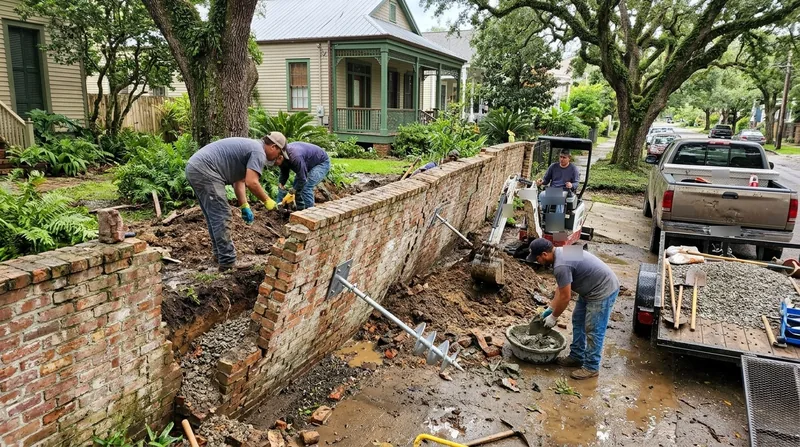




New Orleans sits in a bowl between the Mississippi River and Lake Pontchartrain, and much of the city is below sea level. That means retaining walls here are short, mostly brick planters, poured concrete around raised slabs, old timber bed edges, and bulkheads along the canals. The ground they sit on is soft organic clay and peat, the water table is a few feet down, and summer cloudbursts dump inches of rain in an hour. When that backfill saturates faster than it drains, walls lean, bulge, and sometimes collapse overnight. Leaning & Collapsed Wall Repair in New Orleans is our priority call: we stabilize, correct drainage, and rebuild only what has to be rebuilt. If your wall is still standing but moving, start with our retaining wall repair page before it becomes an emergency.
Why Walls Lean and Fall in New Orleans: Soft Clay, High Water, Hard Rain
Most failures we see in New Orleans are not the wall's fault. The soil under and behind it gives way first. Organic clay and peat compress unevenly, the water table pushes from below, and a single summer storm can load a wall with saturated backfill it was never built to hold. Formosan termites add a second problem in timber and railroad tie walls, hollowing the members from the inside until a section drops.
- Hydrostatic pressure builds when the backfill has no working drain, so the wall bulges outward at mid-height.
- Soft clay and peat settle unevenly, and the footing rotates, which tips the whole wall toward the street or yard.
- Formosan termites hollow old timber and railroad tie walls, and the face falls away without warning.
- Tree roots from live oaks and crape myrtles lift and crack concrete and brick walls within a few feet.
- Downspouts and driveway runoff dump water directly behind low planter walls in Bywater and Mid-City.
Once a wall moves more than an inch or two out of plumb, patching the face does not fix it. The load path has to be corrected from the footing and the drainage.
Key info: In Lakeview and Gentilly, many walls were rebuilt or raised after 2005 on fill that is still consolidating. We see more leaning planter and slab walls there than in older neighborhoods like the Garden District, where brick walls have had decades to settle.
Permits for wall work vary by jurisdiction and are often required above roughly 4 feet from the footing or when the wall carries a surcharge. Check the current rules with the City of New Orleans One Stop before any rebuild, and we will tell you what we expect on your specific wall.
How We Repair a Leaning or Collapsed Wall in New Orleans
We start by finding out why the wall moved, not just where it cracked. On site we probe the backfill, check the footing, and look at where water actually goes during a storm. Then we choose the lightest repair that will hold: anchors and drainage correction for a wall that is leaning but intact, or a partial to full rebuild when the footing or the wall body is gone.
- We inspect the wall, footing, and backfill, and mark the plumb and any bulge so we can measure movement.
- We relieve the pressure first by opening the backfill and correcting or adding drainage behind the wall.
- We install tieback anchors or helical anchors where the wall can be pulled back and stabilized without a full rebuild.
- We remove and rebuild collapsed sections with block, poured concrete, or boulder facing matched to the original wall.
- We restore the surface drainage, downspouts, and grading so water moves away from the wall, not into it.
Every repair ends with a drainage check, because a wall that goes back up without fixing the water will lean again within a season or two.
Key info: A recent job in Harahan had a poured concrete wall along a driveway ramp that had tipped about 3 inches after years of roof runoff hitting the backfill. We anchored it, rebuilt the top course, and rerouted two downspouts. No full replacement needed, and the driveway stayed in service the whole time.
If the wall is too far gone, we scope the rebuild on our retaining wall replacement page, and we handle the drainage side through our retaining wall drainage service.
Repair Approaches We Use on New Orleans Walls
Not every leaning wall needs the same fix. The right approach depends on how far it has moved, what it holds back, and whether the footing is still sound. Here is how we match the method to the wall.
| Approach | Description | Best for |
|---|---|---|
| Tieback anchoring | We drive anchors into stable soil behind the wall and pull the wall back to plumb. | Leaning walls that are otherwise intact, especially concrete and block. |
| Drainage correction | We open the backfill, install drain rock and pipe, and restore grading and downspouts. | Bulging walls and any wall with wet backfill or standing water behind it. |
| Partial rebuild | We remove the failed section, rebuild the footing and wall, and tie it into the sound section. | Collapsed sections, termite-damaged timber, and cracked brick planters. |
| Full rebuild with new drainage | We replace the wall and build the drainage and footing the original wall never had. | Walls that have failed twice, or where the footing is gone. |
We tell you which approach fits before we start, and we do not sell a full rebuild when anchors and drainage will hold the wall.
Leaning & Collapsed Wall Repair Cost in New Orleans: What to Expect
Most leaning and collapsed wall repairs in New Orleans start around $2,500, and that figure covers the common case: a low planter, slab, or driveway wall that has moved but can be anchored and drained. The price climbs with wall length, how deep the failure goes, and whether we have to remove and rebuild a section. Access matters too, since a wall behind a raised shotgun in Bywater is a different job than a bulkhead at the end of a long driveway in New Orleans East.
We look at four things when we price a repair: the length and height of the wall, the condition of the footing, how much backfill has to be opened for drainage, and whether the wall carries a surcharge like a driveway or structure. A wall that has already collapsed costs more than one that is only leaning, because removal and rebuild enter the scope. Getting two or three estimates is smart on any wall over a few feet, and it protects you from a contractor who quotes a full replacement for a wall that can be stabilized.
Our full pricing overview is on the pricing page, and we give you a written scope with the estimate so you can compare line by line.
Hiring a Retaining Wall Contractor Near New Orleans: What to Check
A leaning wall is a structural problem, and the contractor you hire should be able to explain why the wall moved before quoting a fix. Ask for license and insurance certificates, and confirm the policy covers wall and excavation work, not just general labor. Get at least two estimates in writing, and ask each contractor what they plan to do about drainage, since that is where most repairs fail the second time.
Check references on jobs similar to yours, especially low concrete and block walls in older neighborhoods. Ask who pulls the permit if one is required, and confirm the contractor knows the setback and property line rules for your lot. If your wall sits near a protected tree or in a historic district, ask how they handle the review before work starts.
Reach us through the contact page or call (504) 399-7980 for a free estimate.
Leaning & Collapsed Wall Repair in New Orleans: Pricing Guide
| Service | Price | Details |
|---|---|---|
| Leaning wall stabilization with tieback anchors | Starting at $2,500 | Includes site inspection, anchor installation, and plumb correction on a low intact wall. |
| Drainage correction behind an existing wall | Starting at $1,800 | Opens backfill, installs drain rock and pipe, and restores grading and downspout routing. |
| Partial rebuild of a collapsed section | Starting at $3,500 | Removes the failed section, rebuilds footing and wall, and ties into the sound section. |
| Full wall rebuild with new drainage | On estimate | Needs an on-site look at footing, wall length, access, and permit requirements before pricing. |
| Travel | Included | In New Orleans and surrounding areas, no separate call-out or mileage fee. |
| Estimate | Free | Response within 24h at (504) 399-7980, no obligation to book. |
Indicative pricing, the exact cost depends on square footage, finish, and site access. Free personalized estimate within 24h at (504) 399-7980.


