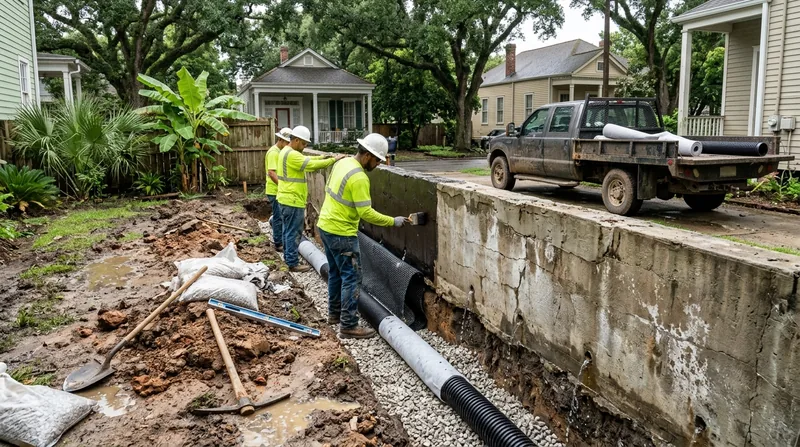




Retaining Wall Drainage in New Orleans: Why Water, Not Gravity, Takes Walls Down
New Orleans sits in a bowl between the Mississippi River and Lake Pontchartrain, and most of the metro is at or below sea level. The ground under Bywater, Mid-City, Lakeview and Gentilly is soft organic clay and peat with a water table a few feet down. That means every retaining wall here, from a brick planter in the Garden District to a poured concrete wall around a raised slab in New Orleans East, is fighting water from behind, not just soil. Retaining Wall Drainage in New Orleans is the work that lets the wall shed that water instead of holding it. We install French drains, weep holes, gravel backfill and waterproofing so hydrostatic pressure never gets the chance to push a wall over. If your wall is already leaning, start with leaning and collapsed wall repair and we will tie the drainage fix into the structural repair.
Why Drainage Decides Whether a New Orleans Wall Survives
Our clay holds water like a sponge and drains slowly, so a summer cloudburst or a hurricane feeder band can saturate the backfill in hours. Once that soil is loaded, hydrostatic pressure builds behind the wall and pushes outward. On a low planter wall in the Marigny that shows up as cracked mortar and a bow; on a taller wall holding a raised slab in Lakeview it shows up as rotation and settlement. Formosan termites make it worse, because they tunnel into damp timber and railroad tie walls and hollow them from the inside.
- We relieve pressure with a perforated French drain at the footing that carries water to daylight or a sump.
- We cut weep holes through concrete and CMU so water exits the wall face instead of soaking the block.
- We place washed gravel backfill and filter fabric so silt does not clog the drain within a season.
- We waterproof the back face of concrete walls to keep the soil from wicking moisture into the mix.
- We grade the top of the wall and the yard behind it so surface water runs away, not into the backfill.
Doing this work before the wall moves is always cheaper than repairing a wall that has already rotated, and it is the single best way to protect a new wall in this soil.
Key info: A railroad tie wall along a Bayou St. John yard in Mid-City looked sound from the street. Weep holes were absent, the ties were soaked, and termites had hollowed the lower courses. The wall was one storm away from failing, and the drainage retrofit is what kept it standing until replacement.
For official guidance on when a wall needs a permit and what an engineered design requires, check the City of New Orleans Department of Safety and Permits at nola.gov/next/safety-and-permits. Thresholds vary by jurisdiction and should always be verified before work starts.
How We Build Drainage That Works in New Orleans Clay
There is no one-size drain here. A low brick planter in Uptown needs weep holes and a gravel curtain. A poured concrete wall holding a raised slab in Gentilly needs a footing drain plus waterproofing. A bulkhead along a drainage canal needs riprap and a drain that survives high water. We inspect the wall, the soil and the grade, then build the system that fits.
- We walk the wall and the yard, check for movement, and locate where water currently ponds or seeps.
- We expose the footing and the back face of the wall, removing wet clay and failed backfill.
- We set a perforated drain pipe in washed gravel, wrapped in filter fabric, with the correct fall to an outlet.
- We cut weep holes at the low points and install gravel and fabric behind each one.
- We waterproof concrete and CMU faces and add a drainage board where the wall is tall.
- We backfill with free-draining material, compact in lifts, and regrade the surface to shed water.
- We test the system with a hose before we close the trench and leave you with the outlet clear.
Every step is done with the wall's existing condition in mind, so a repair and a drainage retrofit can happen in the same visit.
Key info: In Lakeview, a 1970s slab ranch raised after 2005 had a poured concrete wall holding the higher grade. Water was seeping through the face and the wall was bowing. We cut weep holes, installed a footing drain to the street, waterproofed the back face and regraded the yard. The wall has stayed straight through two hurricane seasons.
If you are in the 70128 ZIP around New Orleans East, see our local drainage page for 70128 for the specific soil and grade conditions there.
Drainage Approaches We Use on New Orleans Walls
The right approach depends on the wall material, its height and what it holds back. These are the systems we install most often on low, wet ground.
| Approach | Description | Best for |
|---|---|---|
| Footing French drain | Perforated pipe in washed gravel with filter fabric, graded to an outlet. | Concrete and CMU walls holding raised slabs and driveway ramps. |
| Weep holes and gravel curtain | Holes cut through the wall face with gravel and fabric behind them. | Brick and block planters in Bywater, the Marigny and Uptown. |
| Waterproofing and drainage board | Membrane on the back face plus a dimpled board that channels water down. | Taller poured walls and walls with structures close behind. |
| Surface regrading and swales | Reshaping the yard so runoff moves away from the wall. | Flat lots where water ponds against the wall after storms. |
| Riprap and bulkhead drainage | Stone armoring and drains behind walls along canals and bayous. | Bulkheads and walls exposed to high water and current. |
We often combine two or three of these on the same wall, and the combination is what keeps water from finding the weak point.
Retaining Wall Drainage Cost in New Orleans: What to Expect
Drainage work on a low residential wall in New Orleans starts at From $2,500 for a straightforward retrofit: exposing the footing, cutting weep holes, installing a footing drain and regrading. The number moves with wall length, height and what the wall holds back. A wall supporting a driveway or a raised slab in Lakeview takes more excavation and waterproofing than a garden planter in the Marigny. Access matters too, because a tight side yard off a narrow street means hand digging and more labor hours.
Soil conditions drive cost as much as size. Deep peat and soft clay require more excavation and more gravel, and a high water table can mean a sump and pump. If the wall is already leaning, the repair has to be priced with the drainage, not after it. Getting two or three estimates is smart because the scope can vary widely between contractors, and a low bid that skips the gravel and fabric will cost you again in two years. See our full pricing overview for typical ranges by wall type.
Hiring a Retaining Wall Drainage Contractor Near Me in New Orleans
Ask for proof of license and insurance before anyone touches your wall, and get a certificate of insurance sent directly from the carrier. Get at least two written estimates that spell out the drain type, pipe size, gravel, fabric and outlet, not just a lump sum. Ask for references from jobs in your neighborhood and go look at the walls a year later. Confirm who pulls the permit if your wall is above the local threshold or supports a structure, and check the rules with the local building department. If you are in a historic district or near protected trees, ask about that review early so it does not stall the job.
Reach out through our contact page to schedule a free estimate, or call (504) 399-7980.
Retaining Wall Drainage in New Orleans: Pricing Guide
| Service | Price | Details |
|---|---|---|
| Drainage retrofit on a low planter or garden wall | Starting at $2,500 | Includes weep holes, gravel curtain, footing drain and regrading; wall length and access move the price. |
| Footing drain and waterproofing for a concrete wall | Starting at $4,200 | Includes excavation, perforated pipe, washed gravel, filter fabric and membrane; wall height and surcharge drive cost. |
| Drainage combined with leaning wall repair | On estimate | Structural repair and drainage are priced together after we inspect the wall and soil. |
| Sump and pump for a high water table | Starting at $3,400 | Includes sump basin, pump, discharge line and check valve; discharge route and power access affect the total. |
| Travel | Included | In New Orleans and surrounding areas, no separate call-out or mileage fee. |
| Estimate | Free | Response within 24h at (504) 399-7980, no obligation to book. |
Indicative pricing, the exact cost depends on square footage, finish, and site access. Free personalized estimate within 24h at (504) 399-7980.


