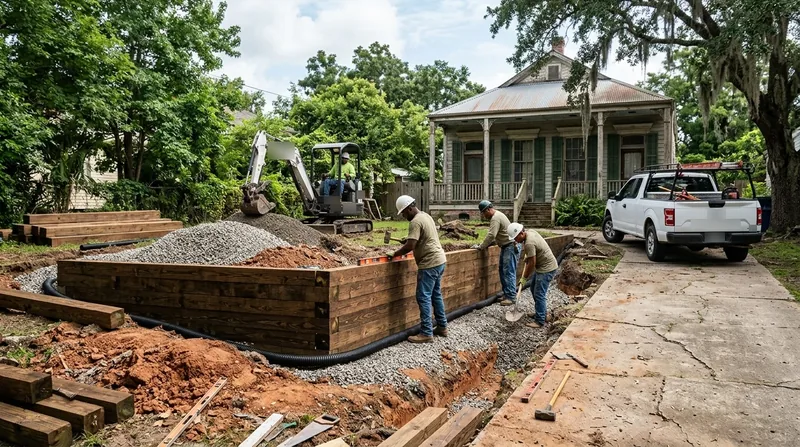




Timber Retaining Walls in New Orleans: Budget-Friendly Beds and Edges That Hold
If you need Timber Retaining Walls in New Orleans, you already know the ground here is not simple. The city sits flat between the Mississippi River and Lake Pontchartrain, much of it below sea level, and the soil under your yard is soft organic clay and peat that moves with every wet season. A timber wall is a practical, low-cost way to hold a raised bed, edge a driveway ramp, or step a small grade change behind a shotgun in Bywater or a slab ranch in Lakeview. We build pressure-treated timber walls with proper drainage and honest guidance on where they work and where they will not last. For a broader look at wall options, see our retaining wall installation page.
Why Timber Walls Fail Fast in New Orleans Soil and Humidity
New Orleans is a tough place for any wood in the ground. The water table sits a few feet down, summer cloudbursts saturate backfill in minutes, and Formosan termites are active across the metro. Timber walls here are low by necessity, most are under three feet, and they serve garden beds, planter edges, and small grade breaks rather than structural retention. When they fail, it is usually rot at the soil line or termite damage long before the wood shows it from the outside.
- Soft clay and peat let a timber wall settle and lean within a few seasons if the base is not dug to stable material.
- Formosan termites attack untreated or poorly rated wood even when it is pressure-treated, especially near slab edges and old stumps.
- Hurricane and summer rain saturate backfill fast, and without drainage the wall pushes out at the bottom.
- Old railroad tie walls from the 1970s and 1980s are now failing across Gentilly and New Orleans East and should be replaced, not patched.
We tell homeowners plainly when timber makes sense and when a longer-lasting material is the better call. If your wall is already leaning, our leaning and collapsed wall repair service is the place to start.
Key info: In Lakeview and Gentilly, we routinely find 1980s railroad tie bed edges that look solid but crumble at the soil line. A homeowner in Metairie called after a tie wall behind her raised slab pushed out during a July storm. We replaced the rotted ties with new pressure-treated timber and added a gravel drainage layer, and the bed has held through two hurricane seasons.
How We Build a Timber Wall That Lasts in New Orleans
We do not drop timber on grade and backfill. In this soil, the base and the drainage decide whether the wall lasts five years or fifteen. We dig to stable material, set the first course on compacted gravel, and build in a slight batter so the wall leans into the load. Every wall gets a gravel backfill zone and a filter fabric wrap so clay does not clog the drainage path.
- We walk the site and check the soil, the slope, and any nearby slab or driveway that adds surcharge.
- We dig a trench to stable material and compact a gravel base before the first timber goes down.
- We set pressure-treated timbers with galvanized fasteners and build a slight batter into the hill.
- We install gravel backfill, filter fabric, and a drainage outlet so water leaves the wall.
- We cap the wall and backfill in lifts, compacting as we go to limit settling.
For a low garden bed in Harahan, that process takes a day. For a tiered bed behind a raised slab in Chalmette, we plan two to three days and coordinate with the homeowner on access.
Key info: A homeowner in the 70128 ZIP code off Dwyer Road had a timber bed edge that had rotted through and was letting soil wash onto the driveway. We removed the old timbers, dug to stable clay, and rebuilt the edge with treated 6x6 timbers and a gravel drainage core. The fix took one day and stopped the washout.
Timber Wall Approaches We Use in New Orleans Yards
Not every timber wall is built the same way, and the right approach depends on the load behind it, the soil, and how long you want it to last. Here are the methods we use most often in New Orleans and the surrounding parishes.
| Approach | Description | Best for |
|---|---|---|
| Single-course timber edge | One course of treated 4x4 or 6x6 set on gravel, pinned, and backfilled with drainage gravel. | Garden beds and low planter edges under 18 inches. |
| Stacked timber wall | Two to four courses of treated timber with deadmen or geogrid tiebacks and a gravel drainage core. | Raised beds and small grade changes up to about 3 feet. |
| Timber-to-block conversion | Remove failing timber or railroad ties and rebuild with segmental block where the wall carries load. | Driveway ramps, raised slabs, and walls that keep failing. |
| Timber with drainage retrofit | Keep sound timber, add gravel backfill, filter fabric, and an outlet to relieve hydrostatic pressure. | Walls that are sound but wet and starting to lean. |
If your wall carries a driveway or a structure, we will tell you straight that timber is the wrong material and point you toward block and segmental retaining walls.
Timber Retaining Walls Cost in New Orleans: What to Expect
Timber is the budget option, and most New Orleans homeowners are looking at a starting point around $20 per square foot for a basic treated timber bed edge. That figure covers removal of the old edge, a gravel base, treated timbers, fasteners, drainage gravel, and backfill. It moves up with wall height, access, and how much soil has to be hauled away.
- Wall height and length drive the square footage and the number of courses, so a 3-foot wall costs more than twice a low edge.
- Access matters in tight Mid-Century lots and Garden District side yards where a wheelbarrow is the only way in.
- Soil and haul-off add cost when the old fill is saturated clay that has to be removed and replaced with gravel.
- Proximity to structures raises the price when the wall sits against a raised slab, driveway, or Creole cottage foundation.
Get two or three estimates and compare what is included, not just the bottom line. Our pricing overview breaks down the details.
Timber Retaining Walls Near Me: How to Hire a Contractor in New Orleans
Hiring for a timber wall near New Orleans is mostly about asking the right questions. Timber is a small-ticket job, and that attracts crews who skip the base and the drainage. Check that the contractor is fully insured, ask for local references, and confirm they pull permits when the wall height or surcharge requires it. The local building department sets the threshold, and it varies by parish.
Ask how they handle termites and drainage, because those are the two things that kill timber walls here. Get the estimate in writing with the scope spelled out, and confirm who hauls off the old material. When you are ready to talk through your project, contact us for a free estimate.
Timber Retaining Walls in New Orleans: Pricing Guide
| Service | Price | Details |
|---|---|---|
| Single-course timber bed edge | Starting at $20/sq ft | Includes old edge removal, gravel base, treated timber, fasteners, and drainage gravel. |
| Stacked timber wall (2 to 4 courses) | Starting at $32/sq ft | Includes tiebacks, gravel drainage core, filter fabric, and compacted backfill in lifts. |
| Timber-to-block conversion | On estimate | Priced after an on-site look at load, soil, and access to the wall face. |
| Drainage retrofit on sound timber | Starting at $18/linear ft | Adds gravel backfill, filter fabric, and an outlet to relieve water pressure. |
| Travel | Included | In New Orleans and surrounding areas, no separate call-out or mileage fee. |
| Estimate | Free | Response within 24h at (504) 399-7980, no obligation to book. |
Indicative pricing, the exact cost depends on square footage, finish, and site access. Free personalized estimate within 24h at (504) 399-7980.


