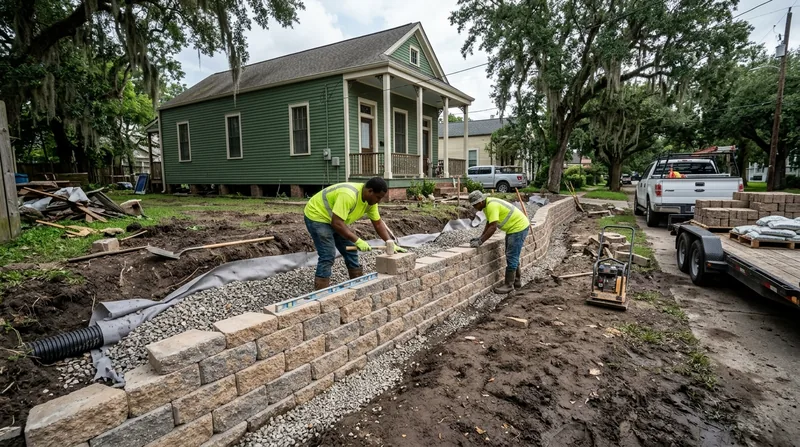




New Orleans sits on soft delta ground between the Mississippi River and Lake Pontchartrain, and much of the city is at or below sea level. That means almost every raised slab, driveway ramp, and garden bed here needs a wall to hold back fill, and that wall has to work on organic clay and peat that moves with every wet season. Retaining Wall Installation in New Orleans is not a cosmetic job. It is a footing, drainage, and soil problem first. We build low walls for shotguns and camelbacks in Bywater and the Marigny, for raised slabs in Lakeview and Gentilly, and for levee-side yards from Arabi to Belle Chasse. We size the footing for the soil we actually find, not for a dry-climate spec sheet. If an existing wall is already bowing or cracked, start with retaining wall repair before the problem spreads.
Why Retaining Wall Installation Matters on New Orleans Soil
The failure mode that dominates here is saturation. A summer cloudburst or a slow tropical system can dump inches in an hour, and the water table sits only a few feet down in most neighborhoods. When backfill turns to soup, hydrostatic pressure pushes on the wall from behind, and a wall with no gravel drainage layer and no weep path will lean within a season or two.
- Soft organic clay and peat settle unevenly, so footings have to be dug to stable bearing and not poured on fill.
- Formosan termites attack timber and old railroad tie walls, which is why so many bed edges in Mid-City and Uptown are hollowed out.
- Hurricane-season rain saturates backfill fast, and a wall without drainage fails from the inside out.
- Raised slabs and driveway ramps in Lakeview and Gentilly add surcharge, so the wall has to be designed for that load.
- Bulkheads and canal-side yards in Arabi and Chalmette face constant wet-dry cycles that work joints loose.
We design every new wall around drainage and bearing capacity first, because those are the two things that decide whether it is still standing after the next storm.
Key info: A block wall we built last spring on a raised slab in Gentilly was set on a gravel footing with a perforated drain and filter fabric behind it. The homeowner had watched two neighbors' walls lean after Hurricane Ida rain. Ours has not moved because the water has somewhere to go.
For permit thresholds and inspection requirements, verify with the City of New Orleans One Stop Shop before any wall goes in. Rules vary by height, surcharge, and lot line.
How We Build a Retaining Wall in New Orleans, Step by Step
Every job starts with a site walk and a soil read. We check where the water table sits, what the existing fill looks like, and whether the wall will carry a slab, a driveway, or just a planting bed. From there we match the wall type to the load and the budget, then build in the order below.
- We mark the wall line and verify setbacks against the property line before we dig.
- We excavate to stable bearing soil and compact a gravel base, because peat and fill will not hold a footing.
- We set the footing and the first course level, checking grade so water runs away from the slab.
- We install a perforated drain pipe, washed gravel, and filter fabric behind the wall.
- We build the wall in lifts, compacting backfill as we go instead of dumping it all at once.
- We cap the wall and restore the grade, then walk the job with you before we pack up.
That sequence is the same whether we are setting block in Harahan or pouring concrete in Metairie, and it is the reason our walls hold on ground that fights back.
Key info: On a driveway ramp in Metairie, the old timber wall had rotted out and the ramp was sagging. We pulled the ties, dug to stable clay, poured a concrete footing, and set a segmental block wall with a drain behind it. The homeowner got a flat, dry ramp back without tearing out the slab.
If your wall is already leaning, see our leaning and collapsed wall repair page before the damage reaches the slab.
Wall Types We Install and Where Each One Fits
Not every wall belongs on every lot. A low garden bed in Uptown calls for a different build than a driveway ramp in Kenner or a levee-side yard in Marrero. The table below shows how we match the approach to the job.
| Approach | Description | Best for |
|---|---|---|
| Poured concrete wall | Cast-in-place wall on a gravel footing with a drain behind it. | Raised slabs, driveway ramps, and walls carrying a surcharge. |
| Block and segmental wall | CMU or interlocking block built in lifts with compacted backfill. | Planter beds, low yard walls, and tiered walls on tight lots. |
| Boulder and natural stone | Rock wall set on stable bearing with gravel drainage behind it. | Garden beds, bayou-side yards, and walls that need to flex with soil movement. |
| Timber wall | Pressure-treated timber built with proper drainage and termite awareness. | Low bed edges and budget-conscious yard walls away from the slab. |
| Drainage-first rebuild | New wall with perforated pipe, gravel, and filter fabric sized for wet soil. | Any wall on soft clay or peat, and any wall that has failed before. |
We pick the wall type after we see the soil and the load, not before, because the wrong match is the reason walls fail here.
Retaining Wall Installation Cost in New Orleans: What to Expect
Most new walls here start around From $30/sq ft for a basic block or concrete wall on a straightforward lot. That figure covers the footing, the drainage layer, and the wall itself. It moves up when the ground is soft, when access is tight, or when the wall carries a slab or a driveway.
- Wall height and length drive the square footage, and taller walls need a bigger footing.
- Soil conditions matter most: peat and fill mean deeper excavation and more gravel.
- Access is a real cost on shotgun lots in Bywater and the Marigny, where a machine cannot reach the back yard.
- Surcharge loads from a raised slab or driveway ramp require a heavier wall design.
- Drainage work, including drain pipe and filter fabric, is priced in because skipping it is how walls fail.
Get two or three estimates on the same scope so you can compare what is actually included, not just the bottom line. Our full pricing overview breaks down how we build a number.
Retaining Wall Installation Near Me: How to Hire a Contractor Near New Orleans
Hiring right matters more here than in most cities, because a wall built for dry ground will fail on New Orleans clay. Ask for proof of license and insurance, and get a certificate of insurance sent directly from the carrier. Get at least two or three written estimates on the same scope, and check references from jobs in your own neighborhood.
Ask how the contractor handles permits when a wall is near a property line or carries a structure, and confirm the plan includes drainage behind the wall. If you live under an HOA, check the rules on wall height and material before you sign anything. A contractor who cannot explain the drainage detail in plain language is not the one to hire.
When you are ready to talk through your lot, contact us for a free estimate and we will walk the site with you.
Retaining Wall Installation in New Orleans: Pricing Guide
| Service | Price | Details |
|---|---|---|
| Block or segmental wall | Starting at $30/sq ft | Includes footing, gravel backfill, and drain; soft clay or tight access raises the rate. |
| Poured concrete wall | Starting at $38/sq ft | Cast on a gravel footing with drainage; surcharge from a slab or ramp adds cost. |
| Boulder or natural stone wall | Starting at $45/sq ft | Rock set on stable bearing with gravel behind; haul distance and stone size move the price. |
| Timber wall | Starting at $25/sq ft | Pressure-treated timber with drainage; termite-prone ground or removal of old ties adds labor. |
| Complex or large-scale job | On estimate | Tiered walls, deep peat excavation, or permit-driven design need an on-site look first. |
| Estimate | Free | Response within 24h at (504) 399-7980, no obligation to book. |
Indicative pricing, the exact cost depends on square footage, finish, and site access. Free personalized estimate within 24h at (504) 399-7980.


