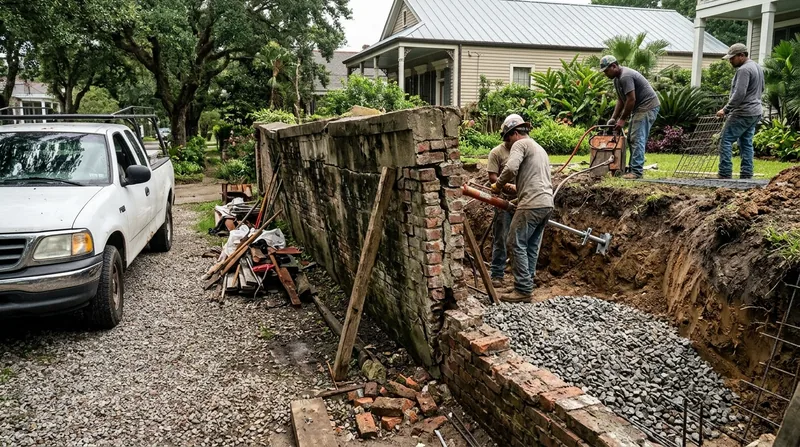




Retaining Wall Repair in New Orleans
When a brick planter starts leaning off a raised shotgun in Bywater or a poured concrete wall buckles behind a Lakeview slab, you need Retaining Wall Repair in New Orleans before the next summer cloudburst finishes the job. This city sits flat and often below sea level between the Mississippi River and Lake Pontchartrain, and the ground under your wall is soft organic clay and peat that moves with every wet season. A wall that was plumb five years ago can bow two inches after a single saturated spring. We repair leaning, cracked, settling, and storm-damaged walls across the metro, from Garden District mansions to 1970s slab ranches in New Orleans East. If the wall is past saving, we tell you straight and walk you through retaining wall replacement instead of patching a losing battle. Call (504) 399-7980 and we will get eyes on it fast.
Why Retaining Walls Fail in New Orleans Soil and Water
The failure mode that dominates here is not frost and it is not coastal spray. It is soft, subsiding clay and peat combined with a water table that sits a few feet down and backfill that saturates during hurricane season and summer downpours. Add Formosan termites chewing through old timber and railroad tie walls, and you get the slow lean that turns into a collapse. Low walls around raised slabs, driveway ramps, planters, and bulkheads along the bayous all carry the same risk.
- Walls lean because the clay footing loses bearing capacity and rotates toward the street.
- Brick and CMU planters crack when hydrostatic pressure builds behind a clogged drain.
- Timber and railroad tie bed edges rot and hollow out from termite damage and constant moisture.
- Poured concrete around raised slabs settles unevenly as the peat compresses under its own load.
- Bulkheads and canal-side walls lose riprap and soil during storm surge and heavy rain.
Every one of these problems gets worse the longer you wait, and the repair cost climbs with it.
Key info: A leaning brick planter wall in Mid-City that looks cosmetic in October can be a genuine collapse risk by the following August. Once the wall tilts past about two inches out of plumb, the backfill is already pushing, and a drainage fix alone will not bring it back.
Permits and local rules matter here too. Many jurisdictions require a permit for walls above roughly 4 feet measured from the footing, or when the wall supports a surcharge like a driveway or structure, and engineered drawings may be needed for tall or tiered walls. Always verify thresholds with the local building department before work starts. You can check the City of New Orleans permit resources at nola.gov One Stop Shop.
How We Diagnose and Repair a Failing Wall in New Orleans
We do not guess at a repair from the curb. We dig in, read the wall, and figure out whether the problem is the footing, the drainage, the backfill, or all three. In a city where the soil is the enemy, the fix has to address water and bearing, not just cosmetics. Here is how a typical repair runs.
- We walk the wall and check plumb, crack width, and soil movement at the base.
- We probe the backfill and inspect drains, weep holes, and any outlet that has clogged.
- We identify the cause, whether it is saturated clay, a failed footing, termite-damaged timber, or storm scour.
- We correct the drainage first so the repair is not fighting water from day one.
- We install tieback anchors, rebuild the footing, or replace damaged sections as the wall requires.
- We backfill with free-draining material and restore the surface so the wall sheds water.
If the wall is already down or past the point of anchoring, we move to leaning and collapsed wall repair and rebuild it right.
Key info: On a Uptown camelback double, a leaning brick planter wall was pulling away from the raised slab. We corrected the drainage, anchored the wall back to sound footing, and rebuilt the cracked section without touching the house. The homeowner avoided a full replacement and a much bigger bill.
Repair Approaches We Use for New Orleans Walls
Not every wall needs the same fix. The right approach depends on the material, the height, how far it has moved, and what is sitting behind it. We match the repair to the failure so you are not paying for a rebuild when an anchor will do, or anchoring a wall that is already gone.
| Approach | Description | Best for |
|---|---|---|
| Drainage correction | Clear clogged drains, add weep holes, install free-draining backfill to relieve hydrostatic pressure. | Cracked brick or CMU planters and walls that bow after heavy rain. |
| Tieback anchoring | Install anchors through the wall into stable soil to pull a leaning wall back to plumb. | Leaning walls that are still structurally sound and have a good footing. |
| Footing rebuild | Remove and replace the failed base with proper bearing and drainage under it. | Walls that settled or rotated because the clay footing gave way. |
| Partial rebuild | Cut out and replace the failed section while keeping the sound wall. | Localized storm damage, termite rot in timber, or a collapsed corner. |
| Full replacement | Tear out and rebuild a wall that is past repair with modern drainage. | Old railroad tie and timber walls that have rotted through. |
We tell you which approach fits your wall and why, so the estimate makes sense before you sign anything.
Retaining Wall Repair Cost in New Orleans: What to Expect
Repair pricing starts from $1,500 for a straightforward drainage correction or a small section rebuild, and it climbs with the scope. A leaning wall that needs anchoring, a footing rebuild, or a partial replacement of a termite-rotted timber wall will run higher. Access matters a lot in this city: a wall tucked behind a raised shotgun in the Marigny or hemmed in by a fence in Gentilly takes more labor than one open to the street.
The height of the wall, the material, how far it has moved, and whether it supports a driveway or structure all move the number. So does the cause. A drainage fix is cheaper than a footing rebuild, and a full replacement of a failed railroad tie wall costs more than anchoring a sound brick wall. We give you a clear scope and a real number, not a vague range. Get 2 or 3 estimates so you can compare scope, not just price. See our full pricing overview for more detail.
What to Look for When Hiring a Retaining Wall Contractor Near New Orleans
Retaining wall repair is not a job for a general handyman. You want a contractor who understands soil, drainage, and load, and who can show you proof of both license and insurance before any work starts. Here is what to check before you hire anyone near New Orleans.
- Confirm the contractor is fully insured, and ask for a certificate of insurance.
- Get 2 or 3 written estimates so you can compare scope and approach, not just the bottom line.
- Ask for references on similar walls in your area, and call them.
- Ask who pulls the permit if the wall is above the local threshold or supports a surcharge.
- Check any HOA or historic district rules that apply to your property before work begins.
Reach out through our contact page or call (504) 399-7980 for a free estimate.
Retaining Wall Repair Near Me: What New Orleans Homeowners Should Know
When you search for retaining wall repair near me, you want a crew that knows this city's soil and water, not a company that treats every wall the same. The walls here fail from saturated clay, a high water table, termites, and storm rain, and the repair has to address those causes or it will not hold. We work across the metro, from Metairie to the West Bank, and we bring the same approach to every wall. Call (504) 399-7980 and we will get out to look at it.
Seasonal Timing for Retaining Wall Repair in New Orleans
Demand here follows the wet season, not the calendar on a brochure. Walls fail and lean most during hurricane season and the summer cloudbursts that saturate the backfill, and that is when homeowners call. The best time to repair is before that pressure builds, in the drier stretch, so the fix is in place when the rain comes. If your wall is already leaning, do not wait for the next storm to make it worse. Call (504) 399-7980 and we will schedule a look.
Retaining Wall Repair in New Orleans: Pricing Guide
| Service | Price | Details |
|---|---|---|
| Drainage correction and minor section repair | Starting at $1,500 | Includes clearing drains, adding weep holes, and rebuilding a small cracked section of wall. |
| Leaning wall anchoring or footing repair | Starting at $2,800 | Covers tieback anchors or a footing rebuild; cost rises with wall height and access. |
| Timber or railroad tie wall partial rebuild | Starting at $3,500 | Replaces rotted, termite-damaged sections; price moves with length and soil conditions. |
| Complex or large-scale repair | On estimate | Tiered walls, storm damage, and walls supporting a surcharge need an on-site look first. |
| Travel | Included | In New Orleans and surrounding areas, no separate call-out or mileage fee. |
| Estimate | Free | Response within 24h at (504) 399-7980, no obligation to book. |
Indicative pricing, the exact cost depends on square footage, finish, and site access. Free personalized estimate within 24h at (504) 399-7980.


