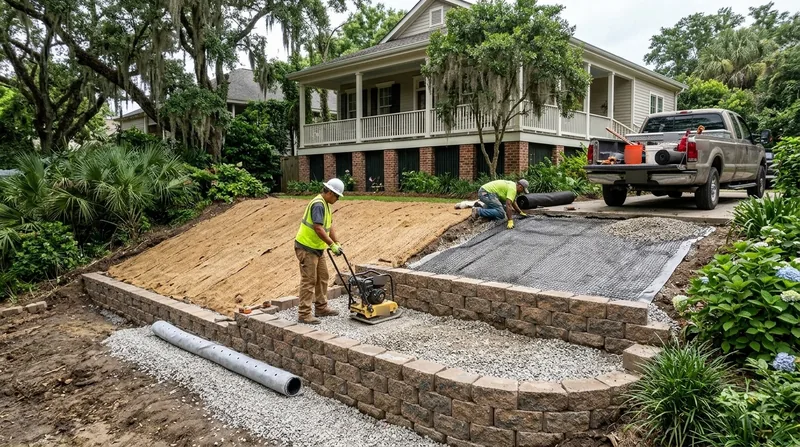




Slope Stabilization & Erosion Control in New Orleans
New Orleans sits in a bowl between the Mississippi River and Lake Pontchartrain, and most of the metro is at or below sea level. The ground under your yard is soft organic clay and peat, the water table is only a few feet down, and summer cloudbursts dump inches in an hour. That combination makes Slope Stabilization & Erosion Control in New Orleans a different job than it is anywhere else. We build low walls, geogrid-reinforced banks, and erosion control systems that hold saturated fill in place along bayous, canals, lakefront edges, levee-side yards, and raised slab lots. If your bank is sliding into a drainage canal or your raised lot is washing out, call New Orleans Retaining Wall at (504) 399-7980 for a free estimate.
Why Slope Stabilization & Erosion Control Matters on New Orleans Soil
Most slope failures we see in New Orleans are not rock-and-gravity problems. They are water problems. The backfill behind a wall or bank saturates during a summer storm, the clay loses shear strength, and the whole mass creeps toward the bayou or the driveway. Formosan termites add another layer when timber or old railroad ties are holding the bank. If you see soil sliding out from under a slab, a leaning bulkhead, or a sinkhole forming at the top of a bank, the clock is running.
- Soft organic clay and peat settle unevenly and pull walls and banks out of line over time.
- A water table two to four feet down keeps backfill saturated, so drainage is as important as the wall itself.
- Hurricane and summer cloudburst rain saturates banks fast, and saturated fill is what actually fails.
- Formosan termites hollow out timber and railroad tie walls, which then lose their grip on the slope.
- Raised slabs and driveway ramps concentrate runoff right at the top of the bank, accelerating erosion.
Every one of these failure modes is manageable, but only if the fix addresses water and soil, not just the visible wall face.
Key info: In Lakeview and Gentilly, we routinely find raised slab lots where the fill edge has eroded two to three feet back toward the house after a single summer storm. The fix is usually a low concrete or block wall with geogrid and a proper drain, not a taller wall.
For official guidance on grading, drainage, and when a permit is required, check the City of New Orleans One Stop Shop before you start any work near a bank or property line.
How We Stabilize a Sliding Bank in New Orleans
We start by finding out where the water is going. On a bayou or canal edge in Marrero or Harvey, that means checking the bank profile, the outfall, and the soil at the toe. On a raised lot in New Orleans East, it means checking the slab edge, the downspouts, and the grade at the top of the bank. Then we build a fix that matches the failure, not a stock wall design.
- We walk the slope and mark the failure plane, the seepage lines, and any utilities before anything gets dug.
- We strip the sloughing soil and shape the bank to a stable grade so the new wall has something solid to bear on.
- We install geogrid in lifts behind the wall to tie the reinforced soil mass back into the stable bank.
- We set drainage (gravel, filter fabric, outlet pipe) so storm water leaves the backfill instead of soaking it.
- We build the wall low and heavy, using concrete, block, or boulder depending on the bank and the access.
- We seed, sod, or riprap the disturbed face so rain does not restart the erosion before the vegetation takes.
On a recent job off Bayou St. John, a homeowner had a timber edge that had rotted out and a bank sliding toward the water. We replaced it with a low block wall, geogrid, and a gravel drain, and the yard has held through two hurricane seasons. For work in the 70128 area, see our Slope Stabilization & Erosion Control in New Orleans (70128) page.
Key info: In Kenner and Metairie, canal-side yards often fail at the toe first. We usually combine a low boulder toe with geogrid and a vegetated upper bank, which holds up better than a single tall wall on that soil.
Slope Stabilization Methods We Use Around New Orleans
There is no single right answer for every bank. The method depends on how steep the slope is, how much room you have, what the bank is holding (a yard, a driveway, a slab), and how close you can get equipment. Here is how we match the approach to the site.
| Approach | Description | Best for |
|---|---|---|
| Low concrete or block wall with geogrid | A short, heavy wall tied back into the bank with layers of geogrid and a gravel drain behind it. | Raised slab lots, driveway ramps, and yard edges where the bank is creeping. |
| Boulder toe with vegetated upper bank | Large rock placed at the toe to stop undercutting, with native grass or sod above. | Bayou, canal, and lakefront edges where the water scours the bottom of the slope. |
| Riprap and erosion blanket | Graded rock or a synthetic blanket pinned to the face to shed runoff without losing soil. | Steep, short banks and outfall channels where a wall is not needed. |
| Timber or railroad tie replacement with drainage | Rotten timber pulled and replaced with a drained, termite-resistant system. | Older bed edges and low garden walls that have rotted or been hollowed by termites. |
| Regrading and surface drainage | Reshaping the slope and adding swales, downspout extensions, or a French drain. | Yards where the bank is still stable but water is pooling and starting to erode. |
We pick the lightest system that will actually hold the bank, because overbuilding on soft clay can cause as many problems as underbuilding.
Slope Stabilization & Erosion Control Cost in New Orleans: What to Expect
Every slope stabilization job starts with a free on-site estimate, and that is the only number worth trusting. The cost depends on the length and height of the bank, how far the soil has already moved, the access for equipment, and whether drainage has to be rebuilt from scratch. A short residential bank fix is a very different job from a canal-edge bulkhead with riprap.
The biggest cost drivers we see locally are access (a back yard in the Garden District with no alley gate costs more than an open lot in New Orleans East), the amount of failed soil that has to be removed, and whether the wall needs engineered design because it supports a driveway or structure. Getting two or three estimates is smart, and it also lets you compare whether each contractor is actually addressing drainage or just rebuilding the visible face.
For a fuller breakdown of how we price retaining wall work, see our pricing overview. We give you a written scope and a fixed number before we start, and we tell you what we found in the soil.
Hiring a Retaining Wall Contractor Near New Orleans: What to Check
Slope work is not a weekend project, and the contractor you pick matters more than the material. Ask for proof of licensing and insurance before anyone walks your bank, and get the certificate sent to you directly from the insurer. Ask how they handle drainage, because a contractor who does not talk about water is going to rebuild the same failing wall.
Check local references on similar banks, not just photos of pretty walls. Confirm who pulls the permit, since many jurisdictions require one for walls above roughly four feet from the footing or when the wall supports a surcharge like a driveway. If your property is near a levee, a canal, or a protected tree, ask about setback and property-line rules early. And if you are in an HOA, get the architectural approval in writing before work starts. Reach out through our contact page and we will walk you through what your specific bank needs.
Slope Stabilization & Erosion Control Near Me: What New Orleans Homeowners Should Know
If you are searching for slope stabilization near me in New Orleans, the first thing to understand is that our failures are water-driven, not gravity-driven. A wall that looks fine in dry weather can be holding saturated clay that is one storm away from sliding. Do not wait for the bank to reach the slab or the driveway.
We work across the metro, from the canal banks in Chalmette and Arabi to the lakefront edges in Slidell and Mandeville. The fix is usually a low, drained, reinforced system, and the earlier we get to it, the less soil you lose. Call (504) 399-7980 and we will get an estimator out to look at the bank.
Slope Stabilization & Erosion Control in New Orleans: Pricing Guide
| Service | Price | Details |
|---|---|---|
| Free on-site estimate | Free estimate | We walk the bank, check drainage and soil, and give a written scope with a fixed number. |
| Low residential bank stabilization | Starting at $2,800 | Short wall with geogrid and drain for a raised lot or yard edge, priced by linear foot. |
| Canal or bayou edge with boulder toe | Starting at $6,500 | Rock toe, geogrid, and vegetated upper bank where water scours the bottom of the slope. |
| Complex or large-scale job | On estimate | Long banks, engineered walls, or tight access need an on-site look before a number is given. |
| Travel | Included | In New Orleans and surrounding areas, no separate call-out or mileage fee. |
| Estimate | Free | Response within 24h at (504) 399-7980, no obligation to book. |
Indicative pricing, the exact cost depends on square footage, finish, and site access. Free personalized estimate within 24h at (504) 399-7980.


