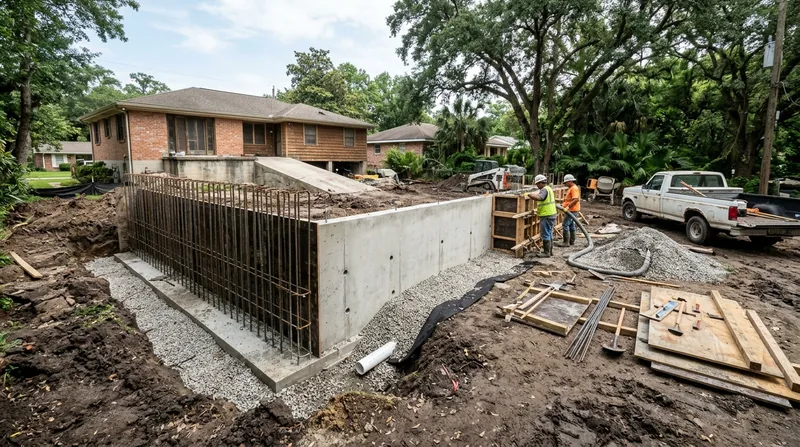




If you own property in New Orleans, you already know the ground under your feet moves. Much of the city sits below sea level, pinned between the Mississippi River and Lake Pontchartrain, and the soil is soft organic clay and peat that shrinks, settles, and shifts with every wet and dry cycle. That is why Concrete Retaining Walls in New Orleans are the go-to solution for holding back soil at raised slab perimeters, driveway ramps, and canal-side yards. A poured concrete or reinforced CMU wall with a proper footing and rebar does what timber and old railroad ties cannot: it resists rot, termites, and the constant push of saturated backfill. We build walls that stay plumb through hurricane season and summer cloudbursts. For a broader look at how walls fit into a full site plan, see our retaining wall installation page.
Why Concrete Retaining Walls Matter in New Orleans Soil and Storm Cycles
New Orleans is flat and wet, and the water table sits just a few feet down in most neighborhoods. When a summer downpour dumps two inches in an hour, the backfill behind any wall saturates fast. Timber and railroad tie walls rot and get eaten by Formosan termites, while unreinforced brick planters crack and lean. Concrete and reinforced CMU walls handle that pressure when they are built with the right footing, rebar, and weep holes.
- Soft clay and peat settle unevenly, so a wall without a proper footing will crack and lean within a few seasons.
- Hurricane and summer storm rain saturates backfill, and without weep holes and drainage stone the wall bulges or fails.
- Formosan termites destroy timber and railroad tie walls, while concrete and CMU resist them completely.
- Raised slabs and driveway ramps in Lakeview and Gentilly put a surcharge on walls that need engineered reinforcement.
- Low brick and CMU planters in Bywater and the Marigny crack from soil movement and need concrete replacement.
If your wall is already leaning, bulging, or showing wide cracks, we handle that under leaning and collapsed wall repair before the problem gets worse.
Key info: In New Orleans, the dominant failure mode is soil settlement and saturated backfill, not frost. A wall built without a proper footing and drainage will lean within five to ten years, even if the concrete itself is sound.
Before you build, check the permit rules with the City of New Orleans One Stop Shop. Many jurisdictions require a permit for walls above roughly 4 feet from the footing, or when the wall supports a driveway or structure, and engineered drawings may be required for tall or tiered walls.
How We Build Concrete Retaining Walls in New Orleans
We start by digging test holes to see what the soil is actually doing, because a lot in Harahan or Metairie can have six feet of soft clay over a sandy lens. From there we design the footing width and rebar schedule to match the wall height and the load behind it. Every wall we pour gets a gravel drainage column, filter fabric, and weep holes so water exits instead of pushing.
- We walk the site and check soil, slope, and how close the wall sits to the house, driveway, or property line.
- We set the footing depth and width based on wall height and the surcharge behind it, then pour and cure the footing.
- We set rebar and form the wall, or lay reinforced CMU block with grout and steel, depending on the look and budget.
- We install drainage stone, filter fabric, and weep holes so storm water drains instead of loading the wall.
- We backfill in lifts and compact, then finish the wall face and cap to shed water.
For a closer look at block-built options, see our block and segmental retaining walls page, and for drainage specifics, see retaining wall drainage.
Local example: On a raised slab in Gentilly, we replaced a rotting railroad tie wall with a 3-foot reinforced CMU wall on a 12-inch footing, with a gravel drain and weep holes every 4 feet. The homeowner gained a dry driveway ramp and stopped the soil from washing into the slab edge.
Concrete Wall Approaches We Use Around New Orleans
Not every wall needs the same build. A low planter wall in the Garden District calls for a different approach than a canal-side bulkhead in Chalmette. Here is how we match the method to the site.
| Approach | Description | Best for |
|---|---|---|
| Poured concrete wall | Solid reinforced concrete formed and poured on site with rebar and weep holes. | Raised slab perimeters, driveway ramps, and tall walls needing maximum strength. |
| Reinforced CMU block wall | Concrete block laid with grout and steel, finished with stucco or a cap. | Planter walls, low garden walls, and walls where a block face is preferred. |
| Cantilever wall | A poured wall with a wide footing that resists overturning from backfill pressure. | Walls over 4 feet, tiered walls, and sites with a surcharge load behind the wall. |
| Gravity wall | A thick concrete or block wall that holds soil by its own mass. | Low walls under 3 feet where space allows a wider base. |
| Bulkhead with riprap | Concrete wall at the water edge with stone armoring against washout. | Canal-side and bayou properties in Chalmette, Arabi, and Belle Chasse. |
The right approach depends on wall height, soil, and what sits behind the wall, so we confirm it on site before we quote.
Concrete Retaining Walls Cost in New Orleans: What to Expect
Concrete retaining walls cost in New Orleans generally start around From $35 per square foot of wall face, and that figure moves with wall height, footing depth, and access. A low planter wall in Uptown is a different job than a 5-foot cantilever wall holding a driveway ramp in Lakeview. Soft soil can require a deeper footing and more rebar, and tight side-yard access means hand digging and smaller equipment.
Other factors that move the number: whether the old wall or railroad ties need removal, how close the wall sits to the house or property line, and whether the wall needs engineered drawings. We give you a written scope so you can compare bids line by line. For a fuller breakdown, see our pricing overview.
Get two or three estimates and ask each contractor what footing depth and drainage they plan to use. The cheapest bid is often the one without a real footing or weep holes, and that wall will lean within a few years.
Hiring a Concrete Retaining Wall Contractor Near Me in New Orleans
When you search for a concrete retaining wall contractor near me in New Orleans, the stakes are higher than in most cities because the soil punishes shortcuts. Start by confirming the contractor is fully insured, and ask for a certificate of insurance before work begins. Get at least two or three written estimates that spell out footing depth, rebar size, drainage, and permit responsibility.
- Ask for local references from jobs in New Orleans, Metairie, or Kenner and call them.
- Confirm who pulls the permit and whether engineered drawings are required for your wall height.
- Check for property-line and setback rules before the crew digs, especially in the French Quarter and Garden District.
- Ask how they handle drainage and weep holes, since saturated backfill is the number one cause of failure here.
If you are ready for a written estimate, contact us and we will set up a site visit.
Concrete Retaining Walls in New Orleans: Pricing Guide
| Service | Price | Details |
|---|---|---|
| Low concrete planter or garden wall | Starting at $35/sq ft | Includes formed wall, rebar, and weep holes; height and access move the price. |
| Reinforced CMU block wall | Starting at $45/sq ft | Includes block, grout, steel, and drainage stone; wall height and finish affect cost. |
| Cantilever or tall wall over 4 ft | Starting at $60/sq ft | Includes engineered footing and rebar schedule; soil depth and surcharge load drive price. |
| Removal of old timber or railroad tie wall | On estimate | We need to see access, rot, and termite damage before quoting removal and haul-off. |
| Travel | Included | In New Orleans and surrounding areas, no separate call-out or mileage fee. |
| Estimate | Free | Response within 24h at (504) 399-7980, no obligation to book. |
Indicative pricing, the exact cost depends on square footage, finish, and site access. Free personalized estimate within 24h at (504) 399-7980.


