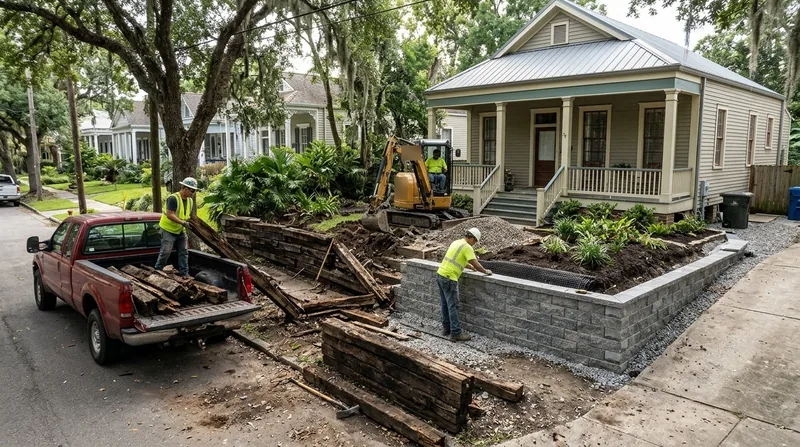




New Orleans sits on soft delta ground between the Mississippi River and Lake Pontchartrain, and a lot of it is at or below sea level. That means the walls holding up your yard, driveway ramp, or raised slab are working against organic clay, peat, and a water table that sits just a few feet down. When a timber edge rots out in Mid-City or a brick planter cracks and leans in Bywater, patching it rarely buys you more than a season. Retaining Wall Replacement in New Orleans means pulling the failed structure all the way out, hauling it off, and rebuilding it with modern materials and real drainage behind it. We work on shotguns and camelbacks, Garden District mansions, and the raised slab ranches of Lakeview and Gentilly. If your wall is still standing but moving, start with leaning and collapsed wall repair before you commit to a full tear-out.
Why walls fail here, and why replacement beats patching in New Orleans
The dominant failure mode in this city is not frost and it is not coastal salt. It is soft, subsiding ground plus water. Organic clay and peat settle unevenly under a wall footing, the water table keeps the backfill saturated, and every summer cloudburst or hurricane rain load pushes on a wall that was never drained properly. Add Formosan termites chewing through timber and railroad ties, and you get walls that lean, bow, crack, or drop a whole section overnight.
- Timber and railroad tie edges rot from the inside out, and termites finish the job faster here than almost anywhere in the country.
- Brick and CMU planters crack along the mortar joints when the footing settles into peat.
- Poured concrete walls around raised slabs and driveway ramps bow when water has nowhere to go.
- Bulkheads and canal-side walls lose backfill through failed riprap and washed-out joints.
- Walls built without gravel and drain pipe saturate within a few seasons and start moving.
Once the footing has settled or the backfill is saturated, patching the face is cosmetic. Replacement resets the base, the drainage, and the material in one pass.
Key info: A railroad tie wall along a Lakeview driveway ramp that has been patched twice is a replacement job, not a repair job. The ties are termite-eaten and the backfill is holding water. Rebuilding with block and a proper drain solves both problems at once.
Permits and structural thresholds vary by jurisdiction, so confirm the current rules with the local building department before any wall above roughly 4 feet or any wall carrying a surcharge. The City of New Orleans One Stop Shop is the place to start for permit questions.
How we tear out and rebuild a wall in New Orleans
We do not guess at what is under a wall. The first step is digging test holes at the footing to see what the wall is actually sitting on, because a wall on peat needs a different base than a wall on compacted fill. From there we plan the tear-out around access, which on tight lots in the Marigny or Uptown often means hand work and a small machine.
- We walk the site, check the footing depth, and note utilities, irrigation, and anything the wall is holding up.
- We pull the permit if the wall height or surcharge triggers one, and we confirm setbacks at the property line.
- We demolish the old wall and haul every bit of it off site, including termite-damaged timber and broken concrete.
- We excavate and compact a proper base, then set gravel and drain pipe against the backfill.
- We build the new wall with engineered materials sized to the load and the soil.
- We backfill in lifts, compact, and leave the site clean and graded.
Every replacement we finish gets a drainage system behind it, because a wall without drainage in this soil is a wall with a countdown on it.
Key info: In Metairie and Kenner, we routinely replace timber bed edges that have settled into the clay. The new wall goes on a compacted gravel base with a drain pipe daylighted to the yard, and the beds stop washing out every storm.
If you are still deciding between rebuilding and starting fresh, compare our retaining wall installation work with a replacement scope. For walls along canals and bayous where the bank itself is moving, slope stabilization and erosion control is often part of the same job.
Replacement approaches we use on New Orleans soil
The right material depends on what the wall holds up and how the ground behaves. A driveway ramp in Gentilly and a garden planter in the Garden District do not need the same wall. Here is how we match the approach to the site.
| Approach | Description | Best for |
|---|---|---|
| Block and segmental replacement | Engineered blocks on a compacted gravel base with drain pipe and filter fabric behind the wall. | Planter walls, bed edges, and low walls that need to flex with settling clay. |
| Poured concrete replacement | Reinforced footing and wall poured to handle surcharge loads, with weep holes and drainage. | Driveway ramps, raised slab edges, and walls carrying a structure. |
| Boulder and natural stone rebuild | Stone set on a stable base with gravel backfill, used where the bank itself is moving. | Bayou edges, bulkhead transitions, and shaded yards in Uptown. |
| Timber and tie replacement | New treated timber set away from soil contact, or a switch to block where termites are active. | Low garden edges and short landscape walls with light loads. |
| Drainage-first rebuild | Full tear-out with new gravel, pipe, and outlet, regardless of the facing material. | Any wall that failed from saturation, which is most of them here. |
We pick the approach after we see the footing and the soil, not before. If the old wall is leaning but still sound, our retaining wall repair service may save you the tear-out.
Retaining Wall Replacement cost in New Orleans: what to expect
Most replacements in this market start around From $35/sq ft and go up from there. That starting figure covers a straightforward tear-out, haul-away, new base, drainage, and a standard block wall on an accessible lot. The number moves when the job gets harder, and in New Orleans the job gets harder in predictable ways.
- Access is the biggest driver. Tight lots in the Marigny and Bywater mean hand demolition and small equipment.
- Wall height and surcharge matter, because a wall holding a driveway or a raised slab needs more material and more base.
- Soil conditions matter, since a footing on deep peat needs over-excavation and imported fill.
- Material choice matters, and block, poured concrete, and natural stone land at different price points.
- Drainage scope matters, because a wall that failed from water needs a full drain system, not just a new face.
We recommend getting two or three written estimates so you can compare scope, not just price. A low bid that skips the drainage is not a lower price, it is a shorter lifespan. Our full pricing overview breaks down how we build a number.
Hiring a retaining wall contractor near New Orleans: what to check
Any contractor can quote a wall. Fewer can tell you what is under it. Ask for proof of license and insurance before work starts, and get a certificate of insurance sent directly from the carrier. Ask how they handle drainage, because a contractor who does not mention drain pipe on a New Orleans wall has not looked at the soil.
Ask for references from jobs in your neighborhood and call them. Confirm who pulls the permit, since many jurisdictions require one for walls above roughly 4 feet or walls carrying a surcharge, and engineered drawings may be needed for tall or tiered walls. Check setback and property-line rules before you dig, and check any HOA or historic district requirements if you are in the Garden District or a designated part of Uptown. We are fully insured, and you can reach us through our contact page for a free estimate.
Retaining Wall Replacement in New Orleans: Pricing Guide
| Service | Price | Details |
|---|---|---|
| Standard block wall replacement | Starting at $35/sq ft | Tear-out, haul-away, compacted base, drain pipe, and new segmental block wall on an accessible lot. |
| Poured concrete replacement | Starting at $45/sq ft | Reinforced footing and wall for driveway ramps and raised slabs, includes weep holes and drainage. |
| Timber and railroad tie replacement | Starting at $30/sq ft | Removal of rotted or termite-damaged ties, new treated timber or block edge, and fresh gravel backfill. |
| Boulder and natural stone rebuild | Starting at $55/sq ft | Stone set on a stable base with gravel backfill, priced by stone size and access to the bank. |
| Complex or large-scale job | On estimate | Tiered walls, walls carrying structures, and deep peat footings need an on-site look before pricing. |
| Estimate | Free | Response within 24 hours at (504) 399-7980, no obligation to book the work. |
Indicative pricing, the exact cost depends on square footage, finish, and site access. Free personalized estimate within 24h at (504) 399-7980.


