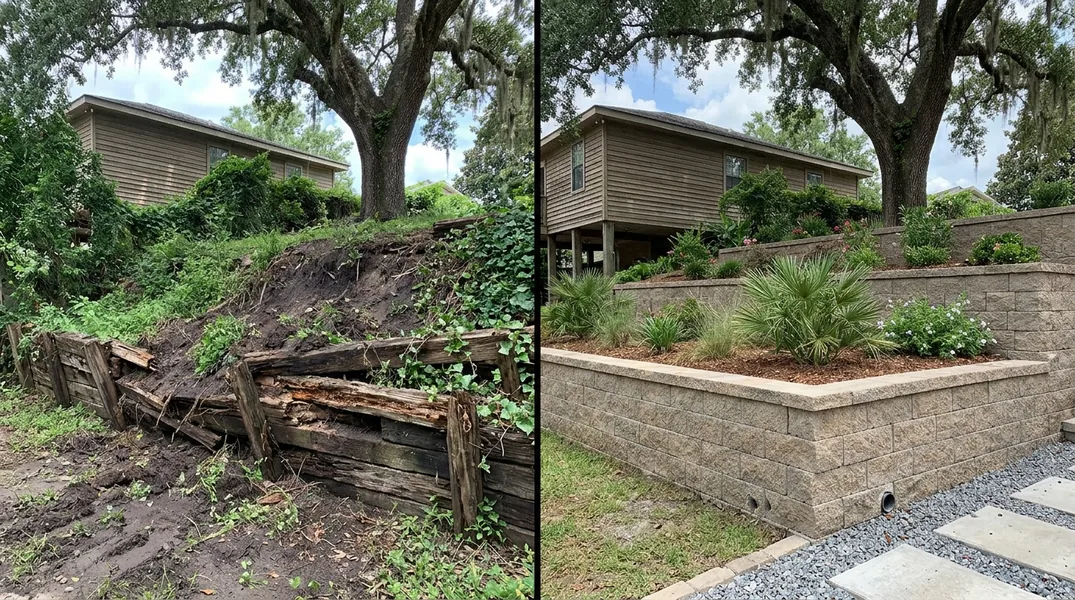
Why New Orleans Soil and Water Demand a Smarter Wall Material
If you live in New Orleans, you already know that the ground beneath your feet is not like the ground in most American cities. Much of the metro area sits on thick layers of soft clay, silt and organic matter, and the water table can be as shallow as a couple of feet below the surface. On top of that, many neighborhoods were built on raised lots that depend on fill dirt to keep homes above street flooding. That combination creates a very specific set of forces acting on any retaining wall, and it is the reason a wall that works beautifully in a dry, rocky climate can fail here in a season or two.
Wet clay expands when it absorbs water and shrinks as it dries, and in New Orleans it rarely gets the chance to fully dry out. That constant cycle pushes and pulls on a wall from behind. A high water table adds hydrostatic pressure, which is the weight of water trying to find a way through or around your wall. Raised lots add another layer of complexity because the wall is often holding back several feet of engineered fill, not native soil. Choosing the wrong material in this environment is not just a cosmetic problem; it can lead to bowing, cracking, settlement and, in the worst cases, collapse.
Concrete Retaining Walls: Heavy-Duty Performance in Saturated Ground
Concrete Retaining Walls are one of the most reliable choices for New Orleans properties because poured concrete is dense, heavy and highly resistant to the moisture that saturates local soil. A properly engineered concrete wall can handle significant lateral loads, which makes it a strong candidate for raised lots where the wall is retaining a deep section of fill. Concrete also resists rot, insect damage and the gradual deterioration that wood walls experience in humid climates. When it is reinforced with steel and poured with the right mix design, a concrete wall can serve a home for decades.
The key word is engineered. A concrete wall that is simply poured without proper footing depth, drainage and reinforcement is a recipe for cracking, especially in expansive clay. Local installers need to account for soil movement, hydrostatic pressure and the frost-free but water-logged conditions we have here. Weep holes, a gravel drainage layer and a properly compacted base are not optional extras in this climate; they are essential. Homeowners who want a long-term solution for a raised lot or a steep grade often find that concrete offers the best balance of strength and longevity, even if the upfront investment is higher than some alternatives.
Block and Segmental Retaining Walls: Flexibility That Handles Clay Movement
Retaining Wall Installation using block or segmental systems has become extremely popular in the New Orleans area, and for good reason. A segmental retaining wall is built from interlocking concrete units that are designed to flex slightly rather than crack under pressure. In a region where clay is constantly shifting with moisture, that flexibility is a major advantage. Segmental walls also drain well when built with the proper gravel backfill, which helps relieve the hydrostatic pressure that builds up behind any wall in a high water table environment.
A block retaining wall can be engineered to impressive heights, especially when geogrid reinforcement is layered into the soil behind the wall. That makes it a practical option for raised lots and for terracing a sloped yard. The block units come in a wide range of colors and textures, so they can look like natural stone or clean modern concrete. One caution for local homeowners: not every block wall is built to the same standard. The difference between a wall that lasts and one that leans comes down to base preparation, compaction, drainage and correct geogrid placement. A qualified installer will design the wall around your specific soil and water conditions, not just stack blocks and hope for the best.
Boulder Retaining Walls: Natural Look, Serious Weight
A boulder retaining wall brings a natural, landscape-friendly look that many homeowners love, and the sheer mass of large stone is very effective at resisting the pushing forces of wet clay. Because boulders are heavy and largely impervious to water, they do not degrade in the way wood or some manufactured materials can. A well-built boulder wall can also be designed with open gaps and a gravel core that allow water to move through rather than build up, which is a real benefit in a city with a high water table.
Boulder walls are not a one-size-fits-all solution, though. They work best on lower walls and on sites where the grade change is moderate. Very tall boulder walls can be difficult to engineer and may require additional reinforcement or a different approach altogether. The stones also need to be set deep enough and with the right batter (a slight lean into the slope) to stay stable. For homeowners in neighborhoods like Metairie or Kenner who want a softer, more organic look for a garden wall or a low terrace, boulders can be an excellent fit when installed by someone who understands local soil behavior.
Retaining Wall Repair and Replacement Near Me: When to Call a Pro
Even a well-chosen wall can run into trouble over time, especially in a climate that stresses structures year-round. Signs that you may need Retaining Wall Repair include visible leaning, cracks that are widening, blocks that have shifted out of line, soil washing out from behind the wall, or water pooling at the base after rain. In New Orleans, these symptoms often point to drainage problems or foundation issues rather than a simple cosmetic flaw, and ignoring them usually makes the problem more expensive to fix later.
Sometimes repair is not enough and Retaining Wall Replacement is the smarter investment, particularly if the original wall was built without proper drainage or was undersized for the load it carries. If you are searching for retaining wall repair near me and you are not sure whether your wall can be saved, a professional assessment is the best first step. A local contractor can evaluate the wall, the soil and the water conditions, then recommend the most cost-effective path forward. You can request a free estimate to get clear answers before committing to any work.
Retaining Wall Installation Cost in New Orleans: What to Budget
Homeowners often ask what a retaining wall will cost, and the honest answer is that pricing depends on several factors that are specific to your property. The height and length of the wall, the material you choose, the depth of the footing required, how much excavation is needed and whether geogrid reinforcement is necessary all affect the final number. A short garden wall in Gretna will cost far less than a tall engineered wall holding back a raised lot in a low-lying part of town.
It is also worth budgeting for proper drainage from the start. In this climate, skimping on drainage is one of the most common reasons walls fail early, and repairing a failed wall costs more than building it right the first time. Material choice plays a role too: boulder and block walls often have different cost profiles than poured concrete, and the site access can affect labor. The best way to get a realistic figure is to have a local professional look at your specific site and provide a written estimate. Call New Orleans Retaining Wall at (504) 399-7980 to discuss your project and get a clear, no-pressure quote for your home.
Looking for a professional retaining wall contractor in New Orleans? New Orleans Retaining Wall responds fast for all your retaining wall needs.
Get a Free QuoteOur services: Retaining Wall Installation · Retaining Wall Repair · Retaining Wall Replacement