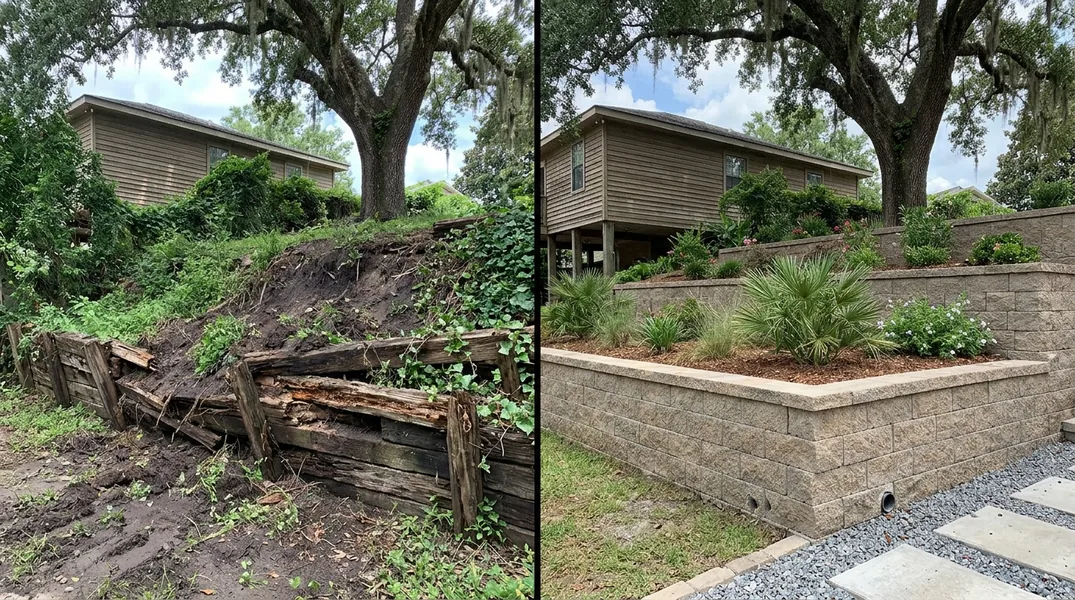
Why New Orleans Retaining Walls Face Unique Water Pressure
If you own property in New Orleans, you already know that water is a constant companion. Between hurricane season, tropical storms, and the city's famously high water table, the soil around your retaining wall is often saturated for days or weeks at a time. That saturation creates a force called hydrostatic pressure, which is the single most common reason retaining walls fail in this region. When water cannot escape, it pushes against the back of the wall with enormous force, and no amount of strong concrete or block can resist that pressure forever.
The problem is compounded by our clay-heavy soil, which drains slowly even in dry conditions. After a heavy rain event, water accumulates behind the wall faster than it can seep away. If your wall was built without a proper retaining wall drainage system, that water has nowhere to go. It saturates the backfill, softens the soil, and begins to push. Homeowners often notice the first signs after a storm: a slight lean, a crack near the base, or soil washing out from around the wall. By the time these symptoms appear, the damage is already underway.
The Role of a Retaining Wall French Drain in Preventing Failure
A retaining wall french drain is the most effective defense against hydrostatic pressure. This system typically consists of a perforated pipe wrapped in filter fabric and surrounded by gravel, installed at the base of the wall behind the backfill. When groundwater rises, it enters the pipe and is redirected away from the wall to a safe discharge point. Without it, water simply pools behind the structure and pushes outward. Many older walls in Metairie and Kenner were built without any drainage at all, which is why we see so many leaning or cracked walls in those neighborhoods after a heavy storm season.
Installing a french drain during new construction is straightforward and relatively inexpensive. Retrofitting one onto an existing wall is more involved but often necessary to prevent further movement. A proper system also includes weep holes or drainage outlets through the wall face, plus a layer of free-draining gravel or crushed stone directly behind the wall to encourage water to move toward the pipe. If you are unsure whether your wall has adequate drainage, a professional inspection can identify missing or clogged components before they cause a collapse. You can request a free estimate to have your wall evaluated.
Warning Signs That Hydrostatic Pressure Is Damaging Your Wall
Hydrostatic pressure retaining wall damage rarely appears overnight. It develops gradually, often over several rainy seasons, and the warning signs are easy to overlook until the wall is in serious trouble. One of the earliest indicators is a horizontal crack running along the middle or lower third of the wall. This type of crack suggests the wall is being pushed outward by water pressure from behind. You may also notice the top of the wall leaning away from the soil it is supposed to hold back, or bulging in the middle. Any of these signs means the wall is no longer performing its job and could fail completely during the next major storm.
Other signs include soil erosion around the base, water pooling at the foot of the wall after rain, and doors or gates that suddenly stick because the ground has shifted. In severe cases, you might see the wall pulling away from adjacent structures or hear creaking sounds during heavy rain. If you spot any of these issues, do not wait for the next hurricane season. Retaining Wall Repair is far less expensive than replacing a collapsed wall, and early intervention can often save the existing structure. A professional assessment will tell you whether repair or full Retaining Wall Replacement is the right path.
How to Protect Your Retaining Wall from Hurricane Rain
The best defense against hurricane rain is a combination of proper design, quality materials, and regular maintenance. If you are planning a new wall, insist on a design that accounts for our local water table and includes a french drain, gravel backfill, and adequate weep holes. Concrete Retaining Walls are often the best choice in this climate because they resist moisture damage and can be engineered to handle high hydrostatic loads. Segmental block walls can also work well when properly reinforced and drained, but the drainage detail is non-negotiable. Never allow a contractor to skip the drain or backfill with clay soil, which traps water and defeats the purpose of the system.
Maintenance matters too. Keep the drainage outlets clear of debris, and check the wall after every major storm for new cracks or movement. Avoid planting large trees or shrubs too close to the wall, as roots can invade the drainage system and create new pathways for water. If your property has poor surface drainage, consider regrading the area above the wall so that rainwater flows away from the structure rather than pooling behind it. Homeowners in Gretna and across the region should also check that downspouts and gutters discharge well away from the wall. For a professional evaluation and pricing on drainage improvements, call New Orleans Retaining Wall at (504) 399-7980.
Retaining Wall Installation Near Me: When to Call a Professional
If you are searching for Retaining Wall Installation near me, you are probably dealing with a wall that is already showing signs of failure or planning a new project and want to avoid the mistakes that lead to drainage problems. A professional installer will evaluate your soil conditions, the slope of your property, and the local water table before recommending a design. This is especially important in New Orleans, where the combination of clay soil and heavy rainfall demands a more robust drainage strategy than in drier parts of the country. A contractor who does not ask about drainage is a contractor you should avoid.
Professional installation also ensures that the wall is built to code and engineered to withstand the loads it will face. Many DIY retaining walls fail within a few years because they lack proper drainage and compaction. A licensed contractor will install the french drain correctly, use the right backfill material, and compact the soil in lifts to prevent settling. If your existing wall is already damaged, a professional can advise whether repair is feasible or whether replacement is the safer investment. To schedule a consultation and get a free estimate, contact New Orleans Retaining Wall today at (504) 399-7980. Protecting your wall from water now is far cheaper than rebuilding it after the next hurricane.
Looking for a professional retaining wall contractor in New Orleans? New Orleans Retaining Wall responds fast for all your retaining wall needs.
Get a Free QuoteOur services: Retaining Wall Installation · Retaining Wall Repair · Retaining Wall Replacement