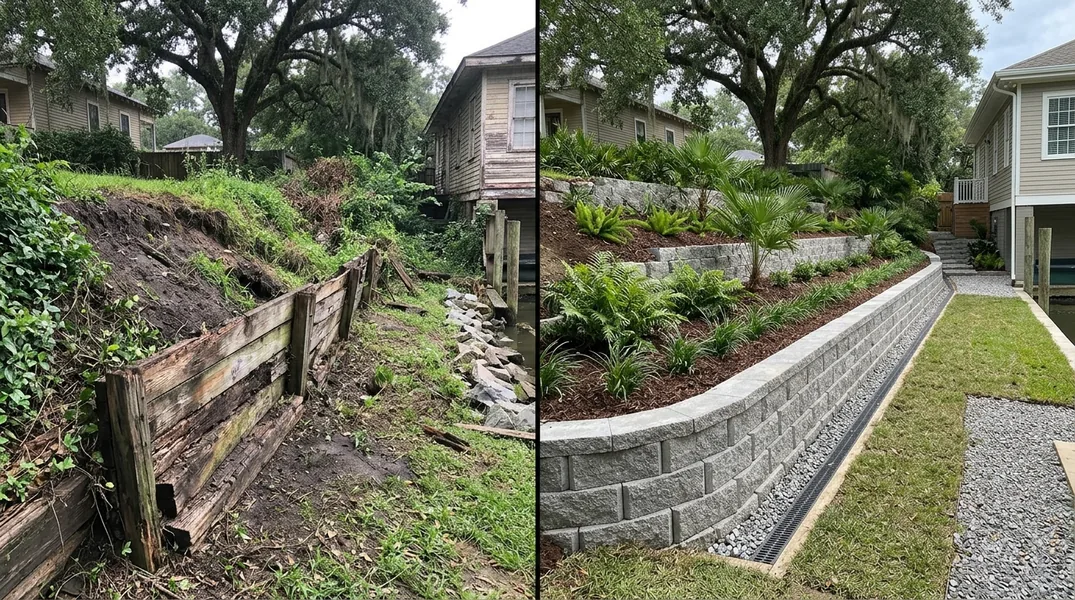
Retaining Wall Cost in New Orleans: What to Budget in 2026
If you are pricing a retaining wall in the New Orleans area, the first number you want is a realistic range, not a teaser. For 2026, most residential retaining walls here land between about $45 and $95 per square foot of wall face, with the typical project falling in the $4,500 to $18,000 range. A short garden wall of 30 linear feet at two feet high might come in near $3,000 to $5,000, while a four-foot engineered wall running 60 feet can push past $20,000 once drainage, footing, and permits are included. The wide spread is normal because wall height, soil conditions, and access change the labor and materials dramatically.
Homeowners often ask about pricing per foot, and that is the right instinct. A useful rule of thumb is $30 to $60 per linear foot for a wall up to three feet high, and $60 to $120 per linear foot once you cross into engineered territory above four feet. Those figures assume standard access and decent soil. In New Orleans, our gumbo clay and high water table frequently add cost, because drainage and base preparation have to be done correctly the first time. A wall that ignores water will lean, crack, or settle within a few seasons.
Retaining Wall Cost Per Foot: Breaking Down the Numbers
The cost to build a retaining wall is really three costs stacked together: materials, excavation and base prep, and finishing. Materials for a segmental block wall typically run $12 to $30 per square foot of face, while poured concrete runs $20 to $45 per square foot. Excavation, hauling, and compacted base add another $8 to $20 per square foot, and drainage (gravel, filter fabric, perforated pipe, outlet) adds $5 to $15 per square foot. On a 50-foot wall at three feet high, that math usually lands between $7,500 and $13,000 before permits and any decorative cap or veneer.
Access is the quiet budget killer. If a truck cannot back within 30 feet of the wall line, crews hand-carry block and wheelbarrow concrete, and that labor shows up in your rates. Tight lots in older neighborhoods, fences that must come down, and mature trees with protected root zones all slow the work. Ask any contractor to quote access assumptions in writing. A bid that assumes easy access and then discovers a narrow side yard is a bid that will grow. The same is true of disposal: in a city where dump fees and haul distances matter, debris removal should be a line item, not a surprise.
What Drives Retaining Wall Cost in New Orleans
Four factors move the number more than anything else: height, soil, water, and permits. Height is not linear. A two-foot wall is a landscaping feature; a five-foot wall is a structure that must resist soil pressure and may require an engineer's stamp and a building permit. Soil matters because much of the metro sits on expansive clay and fill, which means deeper footings and more base aggregate. Water matters because our water table is high and our rain is intense, so drainage design is not optional. Permits matter because the City of New Orleans and surrounding parishes enforce setback and height rules, and unpermitted work can complicate a future sale.
Material choice is the fifth lever. Concrete Retaining Walls cost more up front but need less maintenance and last decades. Segmental block sits in the middle and offers the widest style range. Timber is cheapest but has the shortest life in our wet climate, often 10 to 15 years before rot sets in. If your wall is failing rather than being built new, Retaining Wall Repair can sometimes cost 30 to 50 percent of replacement, but only when the footing and drainage are still sound. A bowed wall with poor drainage is usually a replacement conversation.
Retaining Wall Installation Near Me: When to Call a Pro
Walls under about two feet high, set well away from structures, are often a confident DIY project. Once a wall holds back a slope near a house, driveway, pool, or property line, the risk shifts to you. A failed wall can crack a slab, undermine a fence, or push water into a foundation, and insurance rarely covers poor workmanship. That is the point where Retaining Wall Installation by a local crew is the cheaper decision over five years, even if the invoice is larger today.
Call a professional when you see leaning, bulging, horizontal cracks, soil washing out at the base, or water pooling behind the wall after rain. Call sooner if the wall is taller than four feet or sits within a few feet of a building. We serve homeowners across the metro, including Metairie, Kenner, and Gretna, and we can usually tell from photos whether you are looking at a repair or a Retaining Wall Replacement. Getting a free estimate early is almost always cheaper than waiting for a wall to fail.
How to Get an Accurate Retaining Wall Quote
A good quote is specific. It should list wall dimensions, block or concrete type, footing depth and width, drainage components, excavation and haul-off, permit responsibility, and a completion timeline. It should also state what happens if the crew hits roots, old foundations, or unstable fill. Vague quotes that say "retaining wall, labor and materials" are impossible to compare and easy to inflate later. Ask for the drainage detail in writing, because that is where budget walls cut corners and where New Orleans walls fail fastest.
Get at least two written estimates and make sure both assume the same wall height and finish. A cheap bid on a shorter wall is not a bargain. If you want a straight answer on your property, call New Orleans Retaining Wall at (504) 399-7980 or request a free estimate. We will walk the site, measure the slope, check drainage, and give you a number you can budget against, not a range that changes after the first truck arrives.
Looking for a professional retaining wall contractor in New Orleans? New Orleans Retaining Wall responds fast for all your retaining wall needs.
Get a Free QuoteOur services: Retaining Wall Installation · Retaining Wall Repair · Retaining Wall Replacement